---
title: "SeaSEC 2026: Data fusion as the key to protecting maritime infrastructure"
description: SeaSEC Data2Sea 2026 shows how data fusion and modern technologies improve the protection of maritime infrastructure against hybrid threats.
image: https://news.north.io/hubfs/Unbenannt-3%20(7)-1.png
---

[Skip to the main content.](https://news.north.io/en/de/seasec-2026-recap#main-content)
[](http://north.io/en/)
[](http://north.io/en/)
- Solutions
- [Ocean Data Consulting](http://north.io/en/dataconsulting)
- [Ocean Data Platform](http://north.io/en/dataplatform)
- [Ocean Data Processing](http://north.io/en/dataprocessing)
- [Ocean Data Analytics](http://north.io/en/dataanalytics)
- [Industries](http://north.io/en/industries)
- [Projects](http://north.io/en/projects)
- [Blog](https://news.north.io/en)
- About
- [Company](http://north.io/en/about)
- [Newsroom](http://north.io/en/newsroom)
- [Career](http://north.io/en/career)
- [English](https://news.north.io/en/de/seasec-2026-recap)
- [Deutsch](https://news.north.io/de/seasec-2026-recap)
Search
[Contact Us](http://north.io/en/contact-us)
Toggle Menu
- [English](https://news.north.io/en/de/seasec-2026-recap)
- [Deutsch](https://news.north.io/de/seasec-2026-recap)
Search
Toggle Menu
[Contact Us](http://north.io/en/contact-us)
- Solutions
- [Ocean Data Consulting](http://north.io/en/dataconsulting)
- [Ocean Data Platform](http://north.io/en/dataplatform)
- [Ocean Data Processing](http://north.io/en/dataprocessing)
- [Ocean Data Analytics](http://north.io/en/dataanalytics)
- [Industries](http://north.io/en/industries)
- [Projects](http://north.io/en/projects)
- [Blog](https://news.north.io/en)
- About
- [Company](http://north.io/en/about)
- [Newsroom](http://north.io/en/newsroom)
- [Career](http://north.io/en/career)
6 min read
# SeaSEC 2026: Data Fusion as the Key to Protecting Maritime Infrastructure
[Krueger](https://news.north.io/en/author/krueger) Apr 30, 2026
[Press Release](https://news.north.io/en/tag/press-release) [Event](https://news.north.io/en/tag/event)
-1.png)
Rostock. An underwater drone glides almost silently through the harbor basin of the Warnemünde marina. Due to the shallow water depth, the torpedo-shaped system operates at the surface, although it was originally designed for underwater use.
From there, its sonar scans the seabed and the piers with acoustic waves and generates high-resolution sonar images: Car tires, metal remnants, sediment structures are recognizable - typical signatures of an intensively used harbour area in the Baltic Sea.
During operation, however, a deviation becomes apparent: an angular object that is not present in the reference data from a previous search run.
The recorded sensor data is processed immediately. The "Ocean Data Platform" from north.io is used to compare the data with existing reference data in the "Data Fusion Cell". A change detection process identifies the anomaly. Within a short space of time, the situation becomes clearer: it is an intrusion of the so-called Red Cell, which in military parlance is the training component responsible for enemy detection. German mine divers had previously deposited the object under water in the harbor. They dived into the harbor undetected, while at the same time a rubber dinghy used conspicuous maneuvers to draw the forces and attention of the Reserve Operations Company Sea from Warnemünde and the military police.
.png?width=1200&height=627&name=Unbenannt-1%20(3).png)
This real-life scenario illustrates a fundamental change: today, operational added value is not only created by sensor technology, but in particular by its prompt, integrated digital evaluation.
**Red cell as a reality factor**
The "Red Cell" takes on the role of the enemy during the SeaSEC Challenge Weeks. It is made up of multinational forces from four navies and introduces realistic threat scenarios into the trials, for example through the targeted deployment of objects, mines, acts of sabotage or the use of unmanned systems. Navy combat swimmers are also deployed for this purpose. Frigate captain and mine diver Philipp K., head of the "Red Cell", explains: "Only if we depict realistic threat scenarios can we assess whether the systems deployed will survive under operational conditions. The decisive factor here is not the demonstration, but the resilience in an operational context."
The deployment takes place in a clearly structured exercise environment. Operational areas are clearly defined; in this case, the SeaCat operated in the sea area designated as "NOVEMBER" for military purposes. This standardized procedure facilitates the coordination of complex processes during the exercise. The civilian companies involved quickly became accustomed to these clear military structures and operational procedures..png?width=1934&height=1086&name=Unbenannt-2%20(13).png)
**Strategic context: protecting critical infrastructure**
Maritime infrastructure, such as ports, sea routes, submarine cables and energy facilities, forms a central foundation of modern economies. At the same time, its vulnerability to hybrid threats and targeted disruptive measures is growing.
This security policy relevance is currently particularly evident in the Persian Gulf and the Strait of Hormuz. Incidents there, such as the mining of trade routes, illustrate that even limited interventions can have a significant impact on global supply chains and energy supplies.
Against this backdrop, the ability to detect and assess anomalies in the underwater space at an early stage is becoming increasingly important. The prerequisite for this is a reliable, shared situational picture.
**SeaSEC and the Northern Naval Capability Cooperation**
The SeaSEC Challenge Weeks are part of the "Northern Naval Capability Cooperation" (NNCC). This cooperation format was initiated by Germany, the Netherlands, Denmark, Finland and Sweden in Washington in 2023 to jointly develop capabilities for the protection of maritime infrastructure.
The navy, industry, research and authorities work closely together within SeaSEC. The aim is to transfer technological innovations into application more quickly and to develop interoperable solutions. The next SeaSEC trial is already planned for Sweden.
**Test scenarios**
The trials in Rostock comprised three central deployment scenarios that covered different aspects of protecting maritime infrastructure. In the area of underwater cable protection, a real high-voltage power cable between Germany and Denmark was integrated into the situation in order to test the detection and assessment of potential threats under real conditions. At the same time, the protection of a transformer platform at sea was considered, with the focus on monitoring and securing a maritime energy infrastructure. This was supplemented by the port protection scenario, in which the intrusion of enemy forces, as in the case of the "Red Cell" described above, and the securing of complex port areas were examined.
Six industrial consortia were formed for the implementation of these scenarios, in which companies jointly deployed their respective technologies and tested them together.
**SeaSEC: testing in real operation**
The SeaSEC Challenge Weeks "Data2Sea" were held in the Bay of Rostock from April 13 to 24, 2026. The trials were led by the German Navy and the German Federal Maritime Police in collaboration with the Dutch Navy's Seabed Security Experimentation Center (SeaSEC) and the Rostock Institute for Ocean Technology (RIOT).
With around 40 participating companies, SeaSEC represents a broad-based testing format. In contrast to traditional exercises, the focus is on technological and conceptual development under realistic conditions.
Vice Admiral Jan C. Kaack, Inspector of the German Navy, emphasizes: "These weeks are of high strategic relevance for the German Navy. It is about the further development of our capabilities in the maritime space under changed security policy conditions. Unmanned systems, networked sensor technology and data-driven situational awareness will be decisive for our operational capability in the future."
The reality of these framework conditions was also demonstrated directly on site: the Warnemünde marina was repeatedly approached from sea and land by drones that were not part of the exercise.
.png?width=1680&height=945&name=Unbenannt-2%20(10).png)
**Unmanned systems in an operational context**
One focus of the testing was on the use of unmanned systems (UxV). These enable continuous monitoring, access to hard-to-reach areas and reduce risks for personnel.
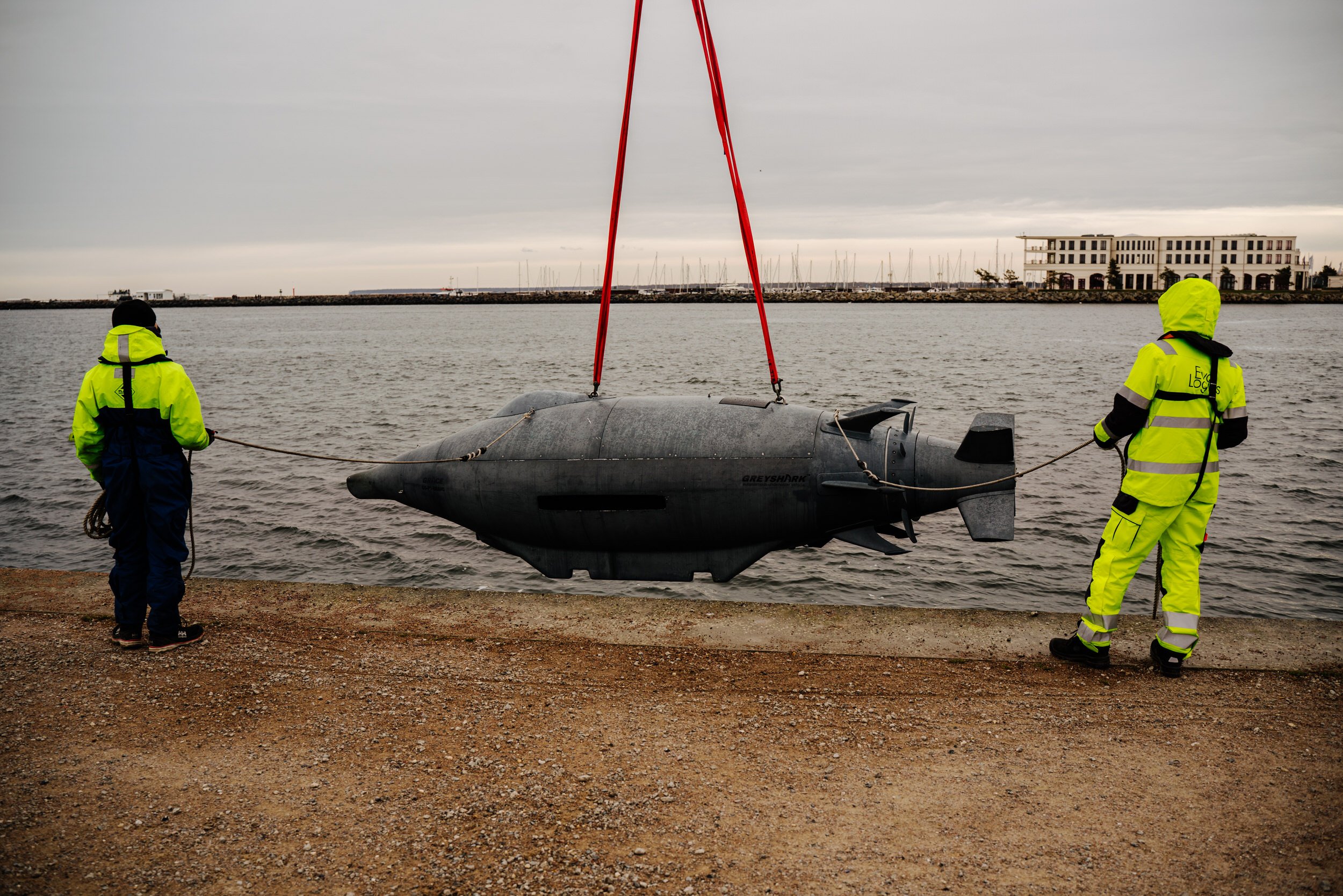
One example is theGREYSHARKTM from EUROATLAS. The autonomous underwater drone was able to transmit sensor data from a distance of around 40 kilometers from the sea. This data was received and integrated into the systems in the port of Warnemünde via an Evologics receiving mast, which is around 10 meters high. The "ping-to-cloud" process, which was used successfully for the first time, enabled almost instantaneous data transmission and processing in real time by north.io.
**Data fusion in the Data Fusion Cell**
The multitude of sensors and platforms generates large amounts of data, the isolated consideration of which only offers limited added value. It is crucial to integrate them into a common situational picture.
A "Data Fusion Cell" was set up for this purpose. In this context, north.io was not involved as an exercise participant, but as part of the international functional team in the SeaSEC staff and was responsible for central data integration.
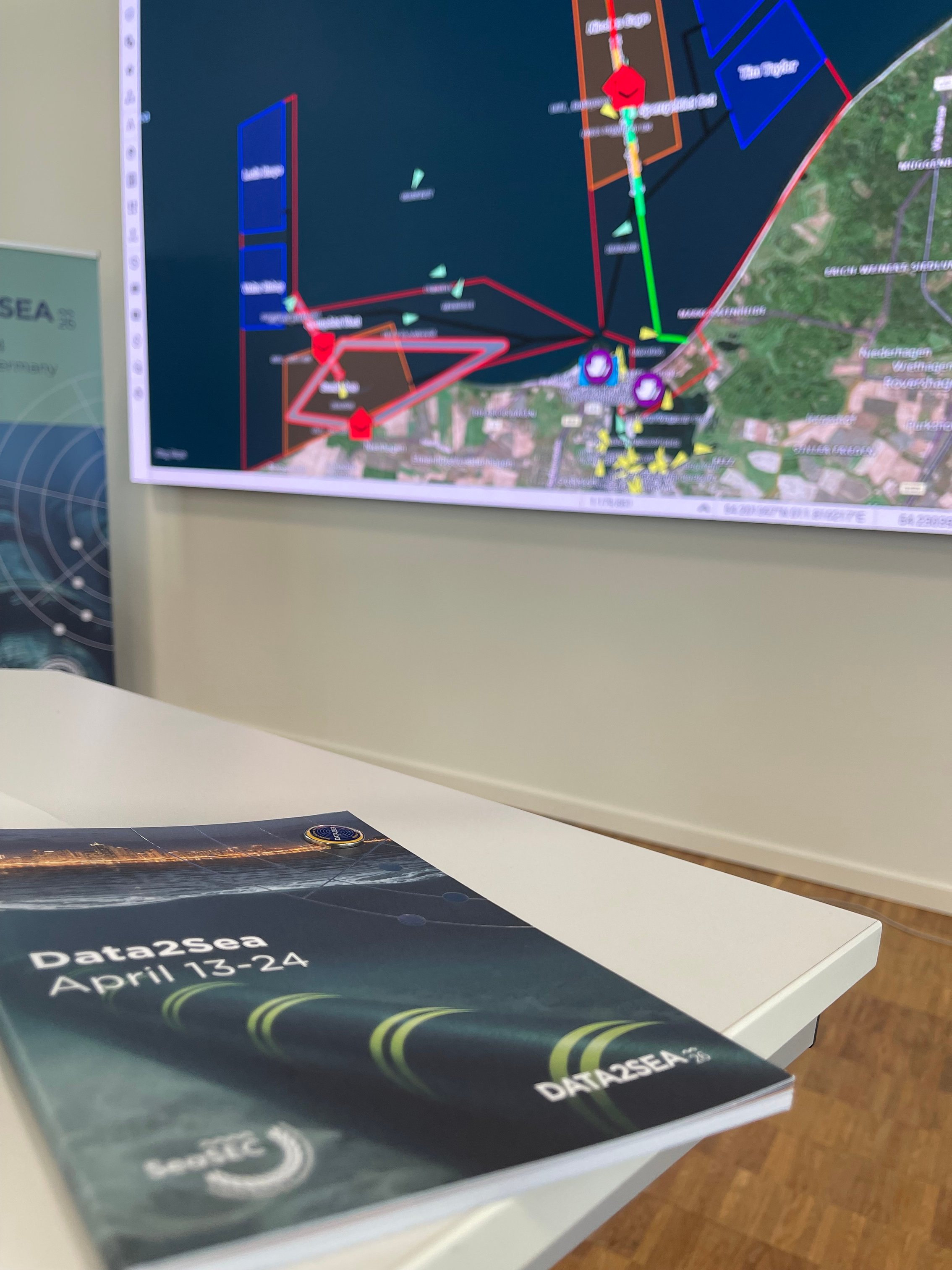
In cooperation with partners such as Systematic ("SitaWare" situation picture software), a continuous data flow was realized right through to the situation picture in the "Operations Room".
Compared to SeaSEC 2025, where data was still partially processed manually, a significantly higher level of automation and processing speed has now been achieved. Carine van Bentum, Director SeaSEC, commented: "By experimenting together, solutions can be implemented much faster. This year has shown the difference that functioning data integration makes: data could be processed much faster and converted into a situation picture." She added that the north.io platform was an important "digital enabler" in this regard.
Jann Wendt, CEO of north.io, also explains: "The operational benefit arises where data from different sources can be merged quickly and reliably. The aim is to create a consistent picture of the situation and thus improve decision-making capabilities during operations."
.png?width=1200&length=1200&name=Unbenannt-3%20(7).png)
1 north.io is a key digital enabler for SeaSEC as part of the Data Fusion Cell.

2 The Data Fusion Cell is responsible for central data integration during the Challenge Weeks.
**Operational experiment (OPEX) as a bridge to utilization**
Parallel to testing, the collaboration between the German Navy and north.io was further expanded as part of an Operational Experimentation (OPEX). This began on April 1, 2026 and forms the framework for the gradual integration of data-driven capabilities.
The participation of north.io in SeaSEC was an integral part of this OPEX. According to the German Navy, the aim is to test technologies under operational conditions at an early stage and develop them iteratively.
Captain Karsten Knecht, Head of Naval Innovation Management at the Eckernförde Naval Command, emphasizes: "We need to bring innovation into use more quickly today. Formats such as SeaSEC, REPMUS and OPEX enable us to test new technologies under realistic conditions at an early stage, develop them further together with industry and introduce products to the troops more quickly."
**Outlook: Continuation with REPMUS 2026**
The collaboration initiated as part of OPEX will be continued during the upcoming international REPMUS 2026 exercise in Portugal. There, the knowledge gained in Rostock will be further developed in a multinational environment and validated under extended operational conditions.
SeaSEC Data2Sea 2026 has shown in summary:
1. The protection of maritime infrastructure requires not only the use of modern platforms, but above all the ability to integrate, evaluate and share complex data situations.
2. A key success factor here was the deliberate, and in some cases "enforced" interoperability through the formation of temporary industry consortia. This structure forced the players involved to interlink their systems and develop joint solutions in an operational context.
3. At the same time, it became clear that information superiority leads directly to decision-making advantages. The basis for this is the near real-time, automated processing of large volumes of data and the parallel execution of operational processes. This makes it possible to identify and evaluate threats more quickly and to initiate appropriate countermeasures.
4. Cross-departmental and inter-agency cooperation is also of central importance. Only a common, consistent situational picture creates a uniform understanding of the situation ("shared situational awareness"), which serves as the basis for coordinated action - both between military forces and with civilian security authorities and other organizations.
Data fusion and information superiority are thus developing into key competencies of modern naval forces - especially in the context of protecting critical underwater infrastructure.
About the author: Former frigate captain Arne Krüger was a commander, mine diver and commander of the naval battalion. Today he advises companies on cooperation with the German Navy.
### You might also like
[](https://news.north.io/en/north.ios-hackathon-team-builds-app-and-wins-the-datarun2023)
1 min read
#### [north.io's Hackathon Team completes App in 24 Hours and wins the DataRun2023](https://news.north.io/en/north.ios-hackathon-team-builds-app-and-wins-the-datarun2023)
Hamburg. The past 5th DataRun of the German Federal Ministry of Transport and Digital Infrastructure (BMDV) from June 9 to 10 was won by the team of...
[.png)](https://news.north.io/en/de/seasec-2026)
#### [SeaSEC 2026: German Navy uses north.io’s Ocean Data Platform](https://news.north.io/en/de/seasec-2026)
Kiel/ Rostock. The Kiel-based Ocean Big Data specialist north.io is accompanying the SeaSEC Challenge Weeks "Data2Sea2026" from 13 to 24 April 2026...
[.png)](https://news.north.io/en/chesapeake-technology-collaboration)
#### [north.io and Chesapeake Technology Announce Collaboration](https://news.north.io/en/chesapeake-technology-collaboration)
Kiel, Germany and New York, USA — north.io GmbH today announced a collaboration with Chesapeake Technology, Inc., the developer of SonarWiz, a...
[](https://news.north.io/en/north.io-presents-marine-dataspace-at-digital-summit)
#### [north.io CEO to present Maritime Data Space project to Chancellor Scholz at Digital Summit](https://news.north.io/en/north.io-presents-marine-dataspace-at-digital-summit)
Kiel/Jena, Germany. At the German government's two-day digital summit on 20 and 21 November 2023 in Jena, Jann Wendt, CEO of north.io, will present...

##### Solutions
- [Ocean Data Consulting](http://north.io/en/dataconsulting)
- [Ocean Data Platform](http://north.io/en/dataplatform)
- [Platform Status](https://status.eu1.trueocean.io/)
- [Ocean Data Processing](http://north.io/en/dataprocessing)
- [Ocean Data Analytics](http://north.io/en/dataanalytics)
##### Company
- [Projects](http://north.io/en/projects)
- [About](http://north.io/en/about)
- [News](https://news.north.io/en)
- [Career](http://north.io/en/career)
- [Legal & Compliance](http://north.io/en/legal-compliance)
##### Connect
- [Contact Us](http://north.io/en/contact-us)
- [Book Demo](http://north.io/en/book-demo)
- [info@north.io](mailto:info@north.io)
- +49 431 3630 540
- [Privacy Policy](http://north.io/en/privacy-policy)
- [Legal Notice](http://north.io/en/legal-notice)
- [Notice under the Digital Services Act](https://form.asana.com/?k=1sTDAlWEm-Xe3KHmSf0FdQ&d=1201843893669132)
- [Whistleblowing](http://north.io/en/whistleblowing-system)
- [Part of Gabler Group](https://gablergroup.com/)
© 2026 north.io. All rights reserved.

```json
{
"@context" : "https://schema.org",
"@type" : "BlogPosting",
"author" : {
"@type" : "Person",
"name" : "Krueger",
"url" : "https://news.north.io/en/author/krueger"
},
"dateModified" : "2026-04-30T13:13:57.323Z",
"datePublished" : "2026-04-30T06:00:47.000Z",
"headline" : "SeaSEC 2026: Data fusion as the key to protecting maritime infrastructure",
"image" : [ "https://news.north.io/hubfs/Unbenannt-3%20(7)-1.png" ],
"mainEntityOfPage" : {
"@id" : "https://news.north.io/en/de/seasec-2026-recap",
"@type" : "WebPage"
},
"publisher" : {
"@type" : "Organization",
"logo" : {
"@type" : "ImageObject",
"url" : "https://news.north.io/hubfs/CMS/Logos/Logo%20White.svg"
},
"name" : "North.io"
}
}
```